Ready to solve challenges and prove your skills on an international stage?
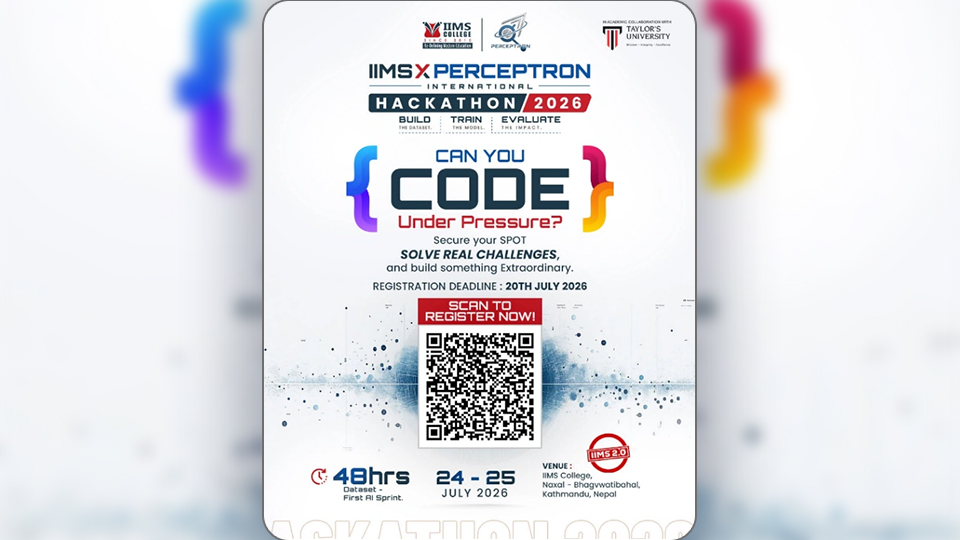
IIMS Hackathon 3.0 powered by Perceptron AI Labs is a 48-hour dataset-first AI sprint where participants will build a complete AI project from the ground up. Teams will identify a real-world problem, create and structure datasets, train AI models, run inference on new data and present their final solution through demos and presentations.
The hackathon focuses not only on coding but also on understanding how real AI systems are developed starting from data collection and preparation to deployment and impact. Participants can experiment across multiple AI domains while learning from mentors, workshops and hands-on collaboration.
📅 Date: 24-25 July 2026
⏰ Duration: 48 Hours
📍 Venue: IIMS College, Naxal, Kathmandu
💻 Mode: Physical for Nepal teams | Virtual for International teams
Register Now: https://acesse.one/21ajum9
💰 Registration Fee: Rs. 5000 per team
📅 Registration Deadline: 20 July 2026
👥 Team Size: Maximum 3 members per team (solo participation not allowed)
🎓 Eligibility: All members must belong to the same institution/college
• Medical AI: Tumor/lesion detection, organ or tissue segmentation, skin lesion classification, X-ray abnormality detection, colon polyp detection, pathology image analysis
• Sports Analytics: Player tracking, ball tracking, action recognition, sports analysis, highlight detection, athlete feedback and team spacing analysis
• Satellite Imaging / Remote Sensing: Land-use classification, building detection, crop monitoring, disaster impact analysis, water body segmentation and urban expansion
• Open Innovation: Custom AI problem areas beyond the listed tracks
• 48-Hour AI Build Sprint: Build datasets, train models and demonstrate real-world impact
• Auta Access: Official dataset creation and labeling platform for the hackathon
• Workshop & Onboarding: Demo sessions to help teams get started with Auta and AI workflows
• Mentorship & Guidance: Support for problem selection, dataset creation, model training and presentations
• Final Demo: Showcase datasets, models, inference results, GitHub repositories and project impact
• Teams are expected to create datasets during the hackathon instead of directly using ready-made labeled datasets
• Public raw images, videos and open datasets may be used responsibly with additional original dataset-building work
• Projects should clearly explain the problem statement, dataset, model, results, limitations and real-world impact
• Medical AI projects must be presented as educational or research prototypes rather than clinically approved diagnostic tools