Training Overview
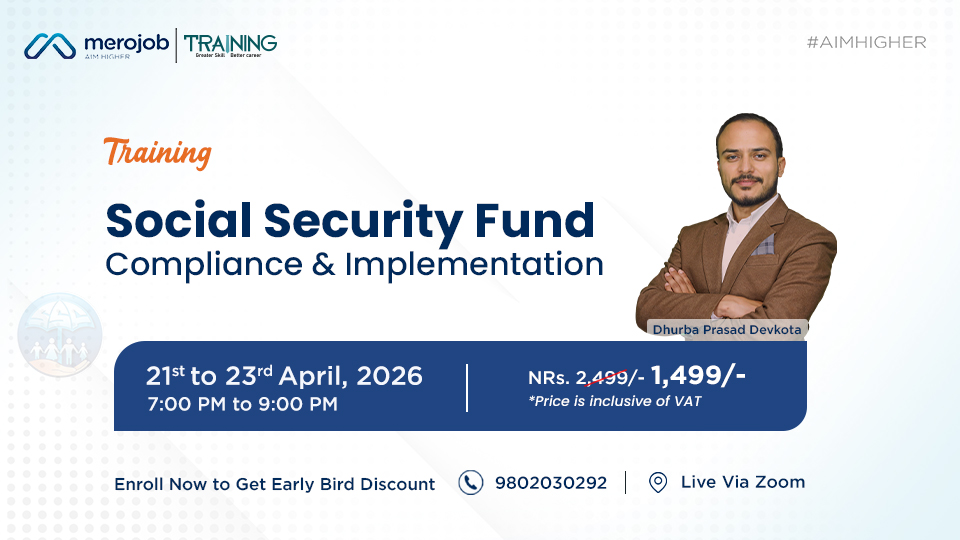
The Contribution-based Social Security Act, 2074, has significantly transformed employer obligations in Nepal. While many organizations understand the 31 percent contribution requirement, very few clearly understand its legal implications, financial impact, and long-term strategic consequences.
This session goes beyond basic compliance awareness and prepares you to understand SSF listing, contributions, schemes, and tax benefits, while also explaining how government policies and budgets are increasingly integrating SSF. It integrates legal clarity, financial modeling, payroll structuring, risk management, and strategic employer planning to help organizations manage SSF effectively and confidently.
Course Content
Day 1: Legal Framework and Employer Risk Exposure
Regulatory Foundation
- Constitutional Right to Social Security (Article 34)
- Labour Act, 2074 (Sections 52 to 57)
- Contribution-based Social Security Act, 2074
- Employer Listing and Employee Enrollment Procedures
- Penalty, Offence and Government Dues Recovery Provisions
Contribution Structure and Employer Obligations
- Employer Contribution: 20 percent
- Employee Contribution:11 percent
- Basic vs Gross Salary Clarification
- Monthly Filing and Payment Cycle
- Inspection Readiness Framework
Day 2: Financial Impact and Strategic Payroll Planning
Cost to Company (CTC) Analysis
- Impact of 20 percent Employer Contribution on Payroll
- Annual Payroll Cost Modeling for SMEs
Financial and Accounting Treatment
- SSF Provisioning and Accounting Entries
- Year-end Audit Implications
- Reconciliation and Internal Control Checklist
Government Policy Context (2082/83)
- Mandatory Coverage Expansion
- Compliance Proof for Company Renewal
Day 3: Benefits, Claims, and Strategic Employer Advantage
Benefit Structure
- Medical Benefits (OPD/IPD & 80/20 System)
- Maternity Benefits
- Accident and Disability Coverage
- Dependent and Death Benefits
- Old Age Pension and Eligibility Conditions
Pension and Loan Facilities
- Pension Calculation and 60 Year Eligibility
- Educational and Housing Loan Facilities
- Claim Management and Documentation Requirements
Strategic HR Advantage
- Employee Retention and Workforce Planning
- Reducing Legal and Financial Risk
- Building Sustainable Compliance Systems
Methodology of Training
- Practical demonstrations using PowerPoint presentations
- Direct Q/A sessions with the expert trainer to make it more interactive
- Real-life examples and case studies will be used to explain key concepts
Payment Options
- Online payment via the Merojob website, bank transfer, or QR code
After Completion of the Course
- All participants will receive Course materials, including presentation slides, recordings, and handouts for future reference.
- Recorded videos will be provided, with a validity period of 3 months from the training date.
- A soft copy of the Certificate of Participation will be provided.
(Training certificate shall be provided after completion of training within 6 working days upon full attendance)
𝗘𝗻𝗿𝗼𝗹𝗹 𝗡𝗼𝘄: https://merojob.com/training/training-on-employee-salary-tax-payroll-compliance-in-nepal