Why do we need theory in the age of engineering-driven AI?
LearnAI Tools
The world is racing toward building powerful artificial intelligences that may pose major risks to the safety and well-being of humanity. Currently, this race is primarily engineering-driven, meaning modern neural networks are grown through an increasingly complex alchemy of decisions regarding architectural design, learning algorithms, and dataset curation.
However, a rigorous scientific and theoretical foundation is still missing to explain why these methods work and to decipher the internal mechanisms behind modern AI systems. Developing this theoretical understanding is crucial for steering these models and ensuring their long-term safety.
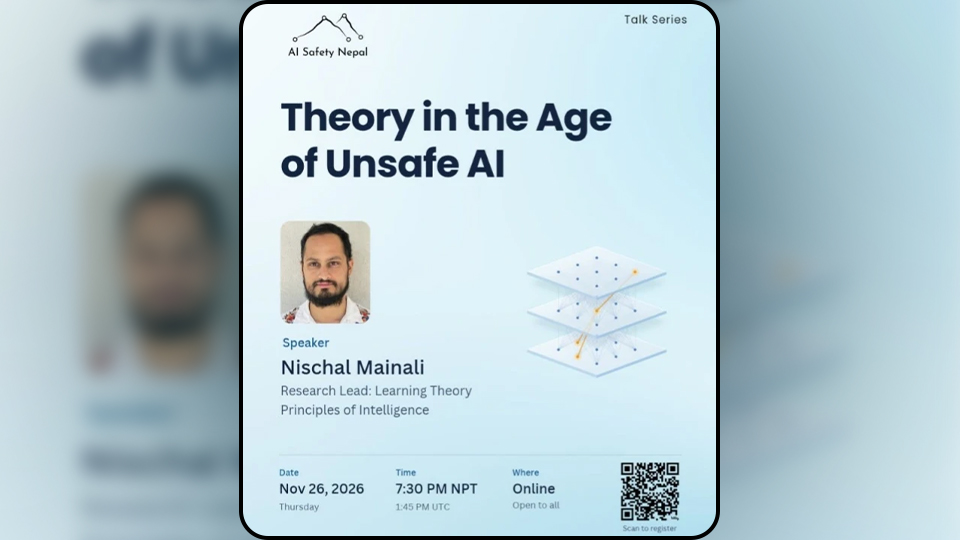
📅 Date: Thursday, November 26, 2026
⏰ Time: 7:30 PM – 8:30 PM NPT (1:45 PM – 2:45 PM UTC)
💻 Mode: Online
During this session, the speaker will cover three key areas:
• Historical Parallels: Draw a comparison between the current state of AI and the invention of the steam engine, highlighting how the subsequent development of thermodynamics was necessary to make the technology safe
• The Frontier of Learning Theory: Present a bird's-eye survey of current advancements in the theory of learning
• Future Outlook: Share perspectives on the future of theoretical research and its direct applications to AI safety
LearnEngineering
Nischal Mainali
Research Lead for Learning Theory at Principles of Intelligence
Nischal works on theoretical models of learning and representations in modern neural networks with a focus on interpretability. Collaborating with Principia, he applies the exactly solvable tradition of learning dynamics theory alongside tools from statistical physics to study feature learning in nonlinear models. He holds a PhD in theoretical neuroscience, where he applied mathematical frameworks to study spatial cognition in the mammalian brain.